Assistive devices for people with mobility impairments, such as powered exoskeletons, rely on accurate locomotion mode recognition to adapt control strategies and provide appropriate assistance during daily activities. However, public benchmarks are typically collected from healthy adults, lack temporally precise labels necessary for detecting mode transitions, or focus on a limited set of tasks.
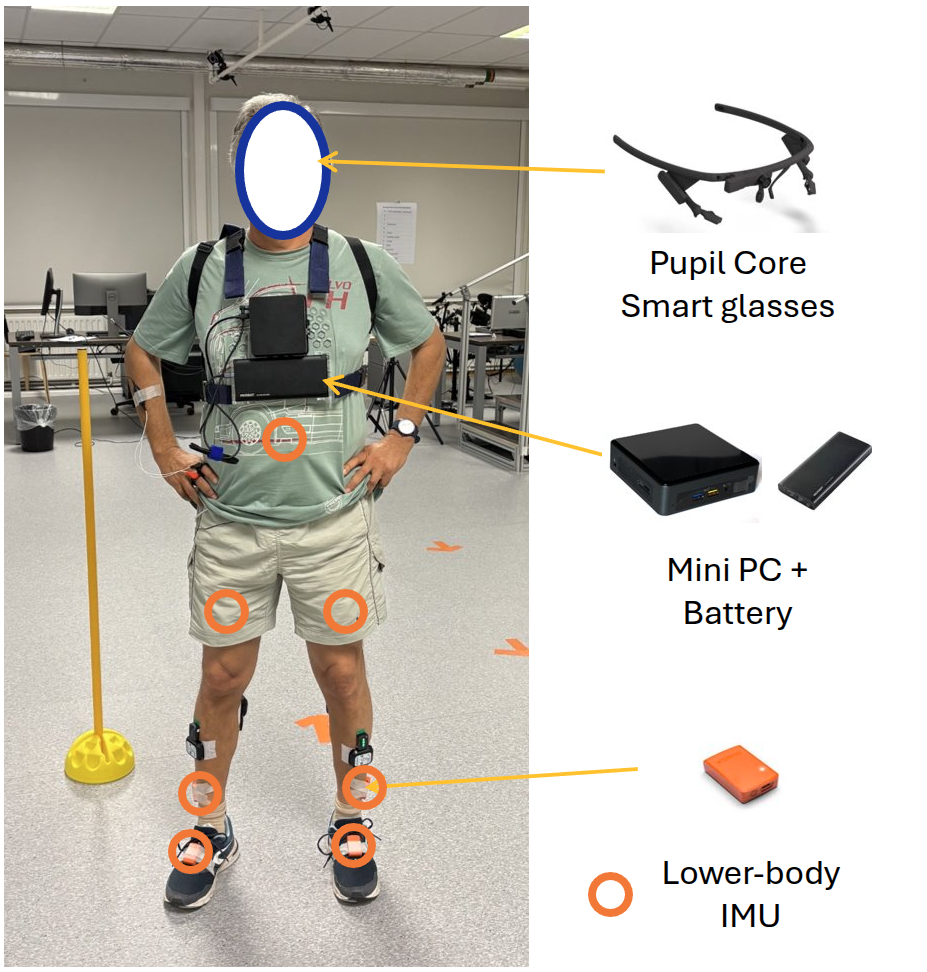
To support development and evaluation under realistic clinical constraints and daily mobility demands, we introduce RevalExo, a functional daily-activity benchmark for inertial and visual locomotion mode recognition. RevalExo is built around a standardized, clinically and ecologically validated daily-activity protocol reflecting the cumulative everyday mobility demands in ageing and clinical populations. The benchmark includes 27 participants across three cohorts: older adults without mobility impairments, stroke survivors, and older adults with probable sarcopenia. The full cohort was recorded with lower-body IMUs, while synchronized egocentric video was collected for a clinically feasible subset of 13 participants. RevalExo provides 10.1 hours of frame-level annotations across 11 locomotion modes, including 5.1 hours of paired inertial and visual recordings.
We benchmark three challenges: unimodal and multimodal locomotion mode recognition across multiple horizons, cross-population generalization from older adults without mobility impairments to clinical cohorts, and vision-guided knowledge transfer to IMU-only models. Results confirm consistent gains from fusing inertial and visual inputs but reveal a substantial gap between general recognition (~93% F1) and recognition during transitions (~68% F1), alongside persistent challenges in cross-population generalization and cross-modal transfer. We release RevalExo to stimulate further research on these open challenges.